(Located on grounds of Portsmouth Historical Society between front corner of town hall & rear corner of church)
LISTEN About the Stone
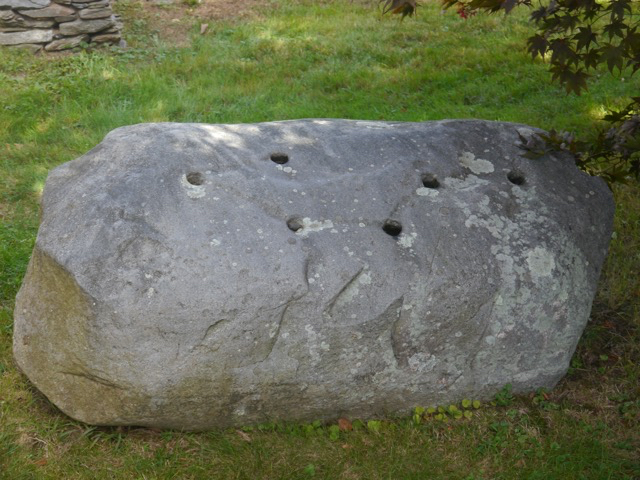
Inscribed Rock: Arnold’s Point Cup Stone
(Presently located on the grounds between town hall and school)
Arnold’s Point Cup stone is the only Portsmouth ‘Inscribed Rock’ known to still exist. It is one of three mentioned in Delabarre’s 1929 article, The Inscribed Rocks of Narragansett Bay. All were located on the shoreline and visible at low tide. The other inscribed stones were at McCorrie’s [variant spellings McCory McCurry used] Point also known as the Fogland Ferry Rock and at Melville Station. In 1929, several once located at Melville and one located on the shore just south of McCorrie’s Point could not be found.
Our rock was relocated from the shore just south of Arnold’s Point. The photo shows a young girl sitting on the rock at its Arnolds Point location. The photograph was taken looking northward from a dilapidated wharf in 1929.
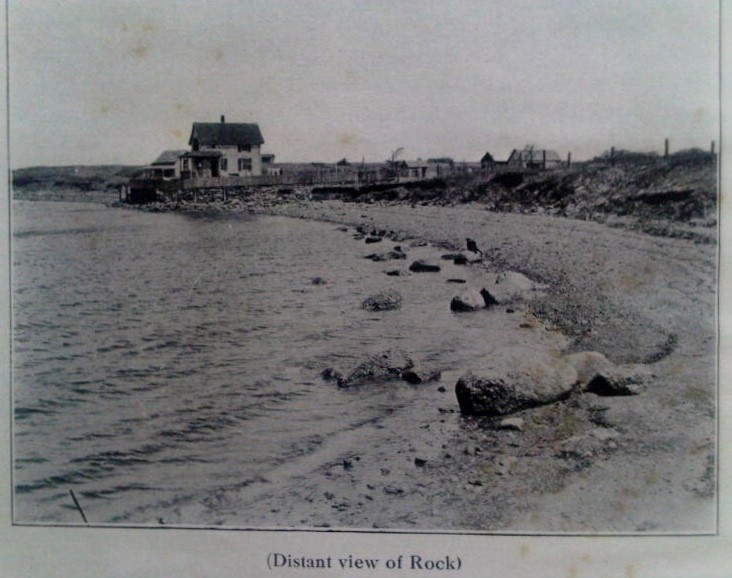
Shown in its original location it was at the edge of the beach at low tide and not visible at high tide. The markings on the predominately sandstone rock are artificial in nature and unique to the other inscribed rocks found in our region. In the 1929 article they describe the holes in the rock as appearing “to have been drilled, and are not circular, but more like triangle with rounded angles. The holes range from 2½ to 3¼ inches in depth. The edges of the holes are described as “not smooth-cut, but broken and roughly beveled. The channels are described as “pecked in, and like the crudely pecked lines of other rocks of this region”. The article also describes the channels as being of varying widths most 3/8 to 5/8 inches and depths usually 3/16 to 3/8 inches.
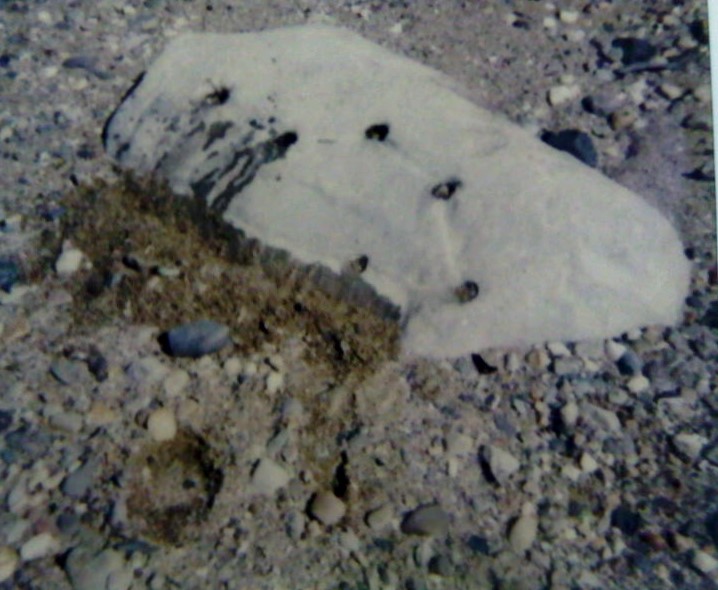
The Arnold’s Point Stone has weathered further giving a rounder appearance to the holes and a smoothing to the channels. There was the impression in 1929 that in the conglomerate part of the stone there may have existed an additional curved channel leading to a seventh shallower hole. This conglomerate channel would have been near the first and second hole. Since then the shallow seventh hole as well as the connecting channel has been almost obliterated.
What are the markings? Who created them? Theories abound.
A speaker who is an expert in Rhode Island geology examined our stone and stated that the marks were definitely manmade through an apparently time consuming process. He could not give further information on it without further research.
David Hutcheson of Washington D.C examined the stone in 1910. His first thought was that it was the Big Dipper but missing the seventh star. Delabarre refers to a consultation with Washington anthropologist by Mr. William H. Babcock. He believed it was an Indian Cup Stone. Other cup stones where attributed to the Wampanoag Native Americans but experts were not as certain of the work on the Arnold Point Stone.
A similar stone in Kensington Minnesota was once estimated to date to the 1362 westward exploration from Vinland. Most modern day scholars now consider it a hoax but it remains on display as an icon. The Minnesota stone has runic letters rather than a constellation. The hole is similar and it was believed the rounded triangular hole, along with a triangular pole, was used the secure water craft to the shore by means of a withy (a rope made of slender twigs). Delabarre acknowledges that while the holes in our stone are similar. He discounted they can be attributed to the Norsemen. He points out that age cannot automatically be attributed to the holes. He found he could use a cold chisel to recreate triangular holes easier than round holes. He also states that the triangular shape is more functional for wedging a stake or bolt into the hole.
Is it an authentic cup-stone?
Most cup-stones have broader, shallower holes but one found on the shore in Scotland has narrow holes of similar depth. The cups can be surrounded with concentric rings but ours is not. In some regions the cups are found without the connecting groves. Groves consistent with ours are found in the stones from Sweden, Ireland and England. As with attempts to explain Dighton Rock, confusion surrounds the meaning of these sculptured marks. In Europe the most widely accepted view is that they are symbols connected with religious rites or beliefs. In our country they are attributed to the Native Americans using a flint drill or gouge but it is not known if they were used as part of their religious symbolism. But Delaware contends that the Arnold Stone was only first mentioned in 1910. If it is truly a cup stone, why was it never mentioned in earlier writings? Since the holes are deeper than traditional cups, could it be that it was created by miners in their idle moments? Was it meant to deceive? The connecting grooves pose a problem in this interpretation as they are cruder and of considerable age, distinctively characteristic of other cup stones. Delabarre hypothesizes that it may well be that the Arnold’s Point Stone is a true cup stone and that the cups but not the channels were altered by miners in the late 1800s.
Interested in more information: Click on this: Arnolds Point Stone Background Story